Wording
How to Write Your Wedding Vows: 3 Frameworks, 8 Real Examples, and What NOT to Say
May 6, 2026 · 10 min read · By Pretty Papery
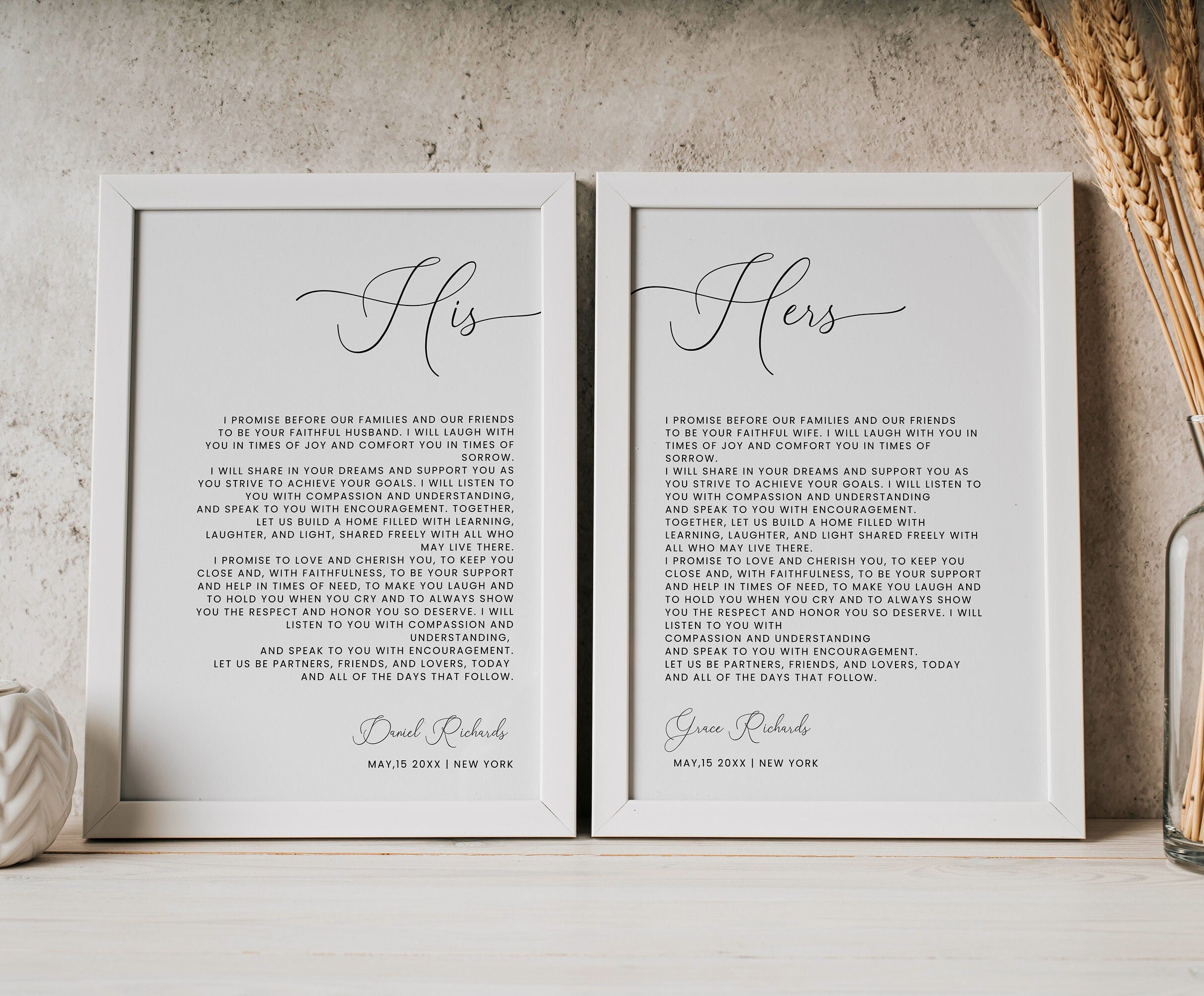
Most wedding vow articles give you templates. Templates produce vows that sound like everyone else's. After reading hundreds of vows over four years (and helping couples through the "I have nothing to say" panic), we've found that what actually helps isn't a template — it's a structure. Pick one of the three frameworks below, fill it with your specifics, and you'll have vows that sound like you and only you.
Why most vows fall flat
Two reasons. First: they're written backwards — the couple starts with "I love you" and tries to find specifics, ending up with abstractions. Second: they confuse length with weight. A four-minute vow that lists every quality of your partner exhausts the room. A 90-second vow that names one specific moment can make people weep.
The fix is structure. The frameworks below are the ones we've seen produce the best vows — emotional without being sentimental, specific without being inside-jokey, the right length without being rushed.
The fix is structure. The frameworks below are the ones we've seen produce the best vows — emotional without being sentimental, specific without being inside-jokey, the right length without being rushed.
Framework 1: Promise–Story–Promise (the most-used)
Three parts, each ~80-100 words.
1. Open with a promise. Not a generic one ("I promise to love you forever") — a specific one rooted in your history ("I promise to keep making coffee for both of us, even when it's your turn.").
2. Tell one story. One. Not a list. The moment you knew, the worst fight you survived, the day they showed up when no one else did. Concrete details: the location, what you were wearing, what they said.
3. Close with three more promises. Specific again, escalating in seriousness. The first light, the second deeper, the third the one that makes the room cry.
This works because it gives the listener a beginning, a memory, and a future. Total length: 200-300 words, about 90 seconds spoken.
1. Open with a promise. Not a generic one ("I promise to love you forever") — a specific one rooted in your history ("I promise to keep making coffee for both of us, even when it's your turn.").
2. Tell one story. One. Not a list. The moment you knew, the worst fight you survived, the day they showed up when no one else did. Concrete details: the location, what you were wearing, what they said.
3. Close with three more promises. Specific again, escalating in seriousness. The first light, the second deeper, the third the one that makes the room cry.
This works because it gives the listener a beginning, a memory, and a future. Total length: 200-300 words, about 90 seconds spoken.
Framework 2: Past–Present–Future (for those who want narrative arc)
Three roughly equal sections, each anchored in time.
Past: Who you were before them. What you didn't know yet. The first time their existence registered. (Avoid: full chronology of the relationship. Pick one moment.)
Present: What's true now that wasn't true then. What they've changed in you. Specific again — not "you've made me a better person," but "you taught me that asking for help isn't weakness, and our therapist has thanked you for that."
Future: The vows. Three to five concrete commitments. Mix the everyday ("to laugh at the same memes for forty more years") with the serious ("to choose you on the days I don't feel like it").
This framework works for couples who like narrative — writers, lawyers, people whose love language is well-constructed sentences.
Past: Who you were before them. What you didn't know yet. The first time their existence registered. (Avoid: full chronology of the relationship. Pick one moment.)
Present: What's true now that wasn't true then. What they've changed in you. Specific again — not "you've made me a better person," but "you taught me that asking for help isn't weakness, and our therapist has thanked you for that."
Future: The vows. Three to five concrete commitments. Mix the everyday ("to laugh at the same memes for forty more years") with the serious ("to choose you on the days I don't feel like it").
This framework works for couples who like narrative — writers, lawyers, people whose love language is well-constructed sentences.
Framework 3: The Letter (for those who hate public speaking)
Write as a letter to your partner. Address them directly throughout: "You," not "my partner." Open with what you want to say if no one else were in the room. Use lowercase if you'd write a letter that way. End with a signature, not a flourish.
Why this works: it solves the "everyone is watching me" problem. You're not performing. You're reading something private out loud, which people instinctively recognise as more intimate than a speech.
The vow becomes the act of speaking the letter publicly — which is itself a kind of vow. Length: 250-400 words. Slightly longer than the other frameworks because you're not building structure, you're being intimate.
Why this works: it solves the "everyone is watching me" problem. You're not performing. You're reading something private out loud, which people instinctively recognise as more intimate than a speech.
The vow becomes the act of speaking the letter publicly — which is itself a kind of vow. Length: 250-400 words. Slightly longer than the other frameworks because you're not building structure, you're being intimate.
8 real example openers — pick the energy you want
Traditional + reverent: "I take you to be my partner. I commit, in the presence of those who love us, to the work of sharing a life."
Specific + grounded: "Three years ago you helped me carry an Ikea wardrobe up four flights of stairs. I knew then. I'm just making it official now."
Humorous + warm: "I promise to never tell you you're being dramatic, even when you absolutely are. I promise to be dramatic with you."
Spiritual without religious: "I've never believed in much. I believe in you. That's the same thing as faith, I think."
Religious (Christian): "In the presence of God and these witnesses, I promise to be your faithful partner — for richer or for poorer, in sickness and in health, until death parts us, and beyond."
Religious (Jewish-inflected): "I am my beloved's, and my beloved is mine. I will choose you, and choose you again, on the days when love feels easy and the days when it requires work."
Modern + irreverent: "I never thought I'd write wedding vows. I thought wedding vows were corny. Then I met you and now I have a Google Doc called 'vows-final-final-actually-final.docx' and we are here, so apparently I was wrong about a lot of things."
The Letter form: "Dear you. The first thing I want to say is that I'm slightly terrified. The second thing is that the only person I'd want next to me when I'm slightly terrified is you. So that more or less covers it."
Pick the energy. Then write your vow in that voice.
Specific + grounded: "Three years ago you helped me carry an Ikea wardrobe up four flights of stairs. I knew then. I'm just making it official now."
Humorous + warm: "I promise to never tell you you're being dramatic, even when you absolutely are. I promise to be dramatic with you."
Spiritual without religious: "I've never believed in much. I believe in you. That's the same thing as faith, I think."
Religious (Christian): "In the presence of God and these witnesses, I promise to be your faithful partner — for richer or for poorer, in sickness and in health, until death parts us, and beyond."
Religious (Jewish-inflected): "I am my beloved's, and my beloved is mine. I will choose you, and choose you again, on the days when love feels easy and the days when it requires work."
Modern + irreverent: "I never thought I'd write wedding vows. I thought wedding vows were corny. Then I met you and now I have a Google Doc called 'vows-final-final-actually-final.docx' and we are here, so apparently I was wrong about a lot of things."
The Letter form: "Dear you. The first thing I want to say is that I'm slightly terrified. The second thing is that the only person I'd want next to me when I'm slightly terrified is you. So that more or less covers it."
Pick the energy. Then write your vow in that voice.
5 things NOT to do
1. Don't list their qualities. "You're kind, you're funny, you're smart…" — every guest's eyes glaze over by quality three. One specific story beats ten qualities.
2. Don't reference inside jokes that need explanation. If you say "remember the kayak incident" and a third of the room laughs while two-thirds wonder what the kayak did, you've just made them all feel excluded. Reference inside jokes only if they're warm without context.
3. Don't write more than 3 minutes. Spoken at normal pace, that's about 400 words. Most vows that bomb are not bad — they're long. Cut ruthlessly.
4. Don't surprise your partner with content you haven't discussed. No public discussion of fertility, finances, exes, or family dynamics. Not because they're inappropriate — but because vows are not the place to ambush your partner with feelings you haven't shared first.
5. Don't read off a phone. Print on cardstock. Phones look performative. Paper looks like it matters. (We make a vow book template for this — small, leather-feel, fits in a hand. Optional but lovely.)
2. Don't reference inside jokes that need explanation. If you say "remember the kayak incident" and a third of the room laughs while two-thirds wonder what the kayak did, you've just made them all feel excluded. Reference inside jokes only if they're warm without context.
3. Don't write more than 3 minutes. Spoken at normal pace, that's about 400 words. Most vows that bomb are not bad — they're long. Cut ruthlessly.
4. Don't surprise your partner with content you haven't discussed. No public discussion of fertility, finances, exes, or family dynamics. Not because they're inappropriate — but because vows are not the place to ambush your partner with feelings you haven't shared first.
5. Don't read off a phone. Print on cardstock. Phones look performative. Paper looks like it matters. (We make a vow book template for this — small, leather-feel, fits in a hand. Optional but lovely.)
Practical writing tips
Write a first draft, then leave it for a week. Vow-writing brain is bad at editing in the moment. Distance reveals what's authentic and what's filler.
Read it aloud, not silently. Different parts of your brain. Sentences that read fine on paper sound stilted out loud. Cut anything that makes you stumble.
Have one trusted reader. Not your partner — a sibling, best friend, or your officiant. Ask: "Does this sound like me?" That's the only question that matters.
Time it. 90 seconds is your target. 2 minutes is fine. 3 minutes is the absolute limit. Use a phone timer when you read it aloud — most couples are surprised how long their draft is.
Print it on something nice. A vow you've handwritten or printed beautifully feels different in your hands on the day. Whatever happens to your speaking voice, the paper carries you.
Read it aloud, not silently. Different parts of your brain. Sentences that read fine on paper sound stilted out loud. Cut anything that makes you stumble.
Have one trusted reader. Not your partner — a sibling, best friend, or your officiant. Ask: "Does this sound like me?" That's the only question that matters.
Time it. 90 seconds is your target. 2 minutes is fine. 3 minutes is the absolute limit. Use a phone timer when you read it aloud — most couples are surprised how long their draft is.
Print it on something nice. A vow you've handwritten or printed beautifully feels different in your hands on the day. Whatever happens to your speaking voice, the paper carries you.